The Gospel according to Mark – 12th Week
A note as Mark’s story continues: This week’s passage, from Mark’s 13th chapter, has been called one of the most difficult passages in the New Testament. Here Jesus discusses ideas and images which would have been familiar to the Jews of his time, but are very difficult for modern readers to understand.
The Day of the Lord: Since the times of the great prophets – Amos, Isaiah, Jeremiah, Joel – the people of Israel had been expecting a future Day of the Lord; but in the century before Jesus’ birth, there was an explosion of writings about it. The writings are usually called “apocalypses” (from the Greek, meaning unveiling). They were attempts to unveil the future, as well as attempts to describe the indescribable. Far more than fundamentalist Christians today, Jesus’ first disciples would have understood that these prophecies were poetry, not prose; that they recorded visions, not science; and that they described dreams, not history.
Understanding what Jesus says: Several strands of apocalyptic thinking are woven into Mark 13. For our purposes this week, the strands have been separated, so we can see them more clearly. (To see the passages in the proper order, open your Bible to Mark 13.)
Warnings about the future of Jerusalem
As he came out of the temple, one of his disciples said to him, ‘Look, Teacher, what large stones and what large buildings!’ Then Jesus asked him, ‘Do you see these great buildings? Not one stone will be left here upon another; all will be thrown down.’
‘But when you see the desolating sacrilege set up where it ought not to be (let the reader understand), then those in Judea must flee to the mountains; someone on the housetop must not go down or enter the house to take anything away; someone in the field must not turn back to get a coat. Woe to those who are pregnant and to those who are nursing infants in those days! Pray that it may not be in winter. For in those days there will be suffering, such as has not been from the beginning of the creation that God created until now, no, and never will be. And if the Lord had not cut short those days, no one would be saved; but for the sake of the elect, whom he chose, he has cut short those days.
The end of the Temple: the magnificent Temple was one of the wonders of the ancient world; it seemed so magnificent and so solid that it would stand forever. But Jesus prophesies that after the Day of the Lord, not one stone will be left to stand upon another.
The abomination of desolation (from the Hebrew, meaning the profanation that appalls) refers to the time in the second century B.C. when Antiochus, seeking to stamp out the Jewish religion, desecrated the Temple by offering pig’s meat as a sacrifice on the great altar. Antiochus also set up public brothels in the Temple courts. Jesus prophesies that this type of sacrilege is going to happen again.
Warnings about persecutions
‘As for yourselves, beware; for they will hand you over to councils; and you will be beaten in synagogues; and you will stand before governors and kings because of me, as a testimony to them. And the good news must first be proclaimed to all nations. When they bring you to trial and hand you over, do not worry beforehand about what you are to say; but say whatever is given you at that time, for it is not you who speak, but the Holy Spirit. Brother will betray brother to death, and a father his child, and children will rise against parents and have them put to death; and you will be hated by all because of my name. But the one who endures to the end will be saved.
The persecution of Jesus’ followers: As we know from history, the early Christians would be brought before councils, both Jewish and Roman; members of their own families would betray them; and they would be slandered. The most serious slander would be the popular rumor that they were cannibals, a charge supported by Jesus’ words remembered in the Eucharist: “This is my body; this is my blood.”
Warnings about heresies
When he was sitting on the Mount of Olives opposite the temple, Peter, James, John, and Andrew asked him privately, ‘Tell us, when will this be, and what will be the sign that all these things are about to be accomplished? Then Jesus began to say to them, ‘Beware that no one leads you astray. Many will come in my name and say, “I am he!” and they will lead many astray.
And if anyone says to you at that time, “Look! Here is the Messiah!” or “Look! There he is!”—do not believe it. False messiahs and false prophets will appear and produce signs and omens, to lead astray, if possible, the elect. But be alert; I have already told you everything.”
Heresies: Heresies (from the Greek meaning choice, or chosen) develop when human beings – wanting to fully understand God, wanting to fully define God – find themselves trying to describe the indescribable. Because human beings can never fully comprehend the divine, we may choose to stress one part of the truth to the neglect of another.
Thus, if we are concerned primarily with describing God’s holiness, we may end up believing that human beings are so imperfect that they can never approach God. (What do Jesus’ life and teachings tell us about God’s holiness?)
If we are concerned mainly with describing God’s justice, we may end up believing that God is so judgmental that we are always afraid of God. (What do Jesus’ life and teachings tell us about God’s justice?)
If we are concerned mainly with describing God’s love, we may end up with a faith that is easy-going and even sentimental. (What do Jesus’ life and teachings tell us about God’s love?)
However much we struggle to understand God, we must always come back to Jesus as the guide to our understanding; and however much we want to be independent thinkers, we need to stay in dialogue with the Christian community – because whenever we get off-center, others can help us see the larger picture.
Warnings about prophesies
'When you hear of wars and rumors of wars, do not be alarmed; this must take place, but the end is still to come. For nation will rise against nation, and kingdom against kingdom; there will be earthquakes in various places; there will be famines. This is but the beginning of the birth pangs.
‘But in those days, after that suffering, the sun will be darkened, and the moon will not give its light, 25and the stars will be falling from heaven, and the powers in the heavens will be shaken. Then they will see “the Son of Man coming in clouds” with great power and glory. Then he will send out the angels, and gather his elect from the four winds, from the ends of the earth to the ends of heaven.
‘From the fig tree learn its lesson: as soon as its branch becomes tender and puts forth its leaves, you know that summer is near. So also, when you see these things taking place, you know that he is near, at the very gates. Truly I tell you, this generation will not pass away until all these things have taken place. Heaven and earth will pass away, but my words will not pass away. But about that day or hour no one knows, neither the angels in heaven, nor the Son, but only the Father. Beware, keep alert; for you do not know when the time will come. It is like a man going on a journey, when he leaves home and puts his slaves in charge, each with his work, and commands the doorkeeper to be on the watch. Therefore, keep awake—for you do not know when the master of the house will come, in the evening, or at midnight, or at cockcrow, or at dawn, or else he may find you asleep when he comes suddenly. And what I say to you I say to all: Keep awake.’
Thinking about the story: In our time, the era of “Left Behind” (the fabulously successful series of books imagining the Day of the Lord in great detail), it is helpful to turn again to Jesus, our only guide to deeper understanding of our faith. Jesus himself says he does not know when the Day of the Lord will come – only God knows, and Jesus is willing to leave the matter in God’s hands.
But Jesus does tell us what we can do while we wait for the end of time: Stop being fearful, stop our endless speculating, and get on with the work God has given us to do.

Donna Ross

About Me
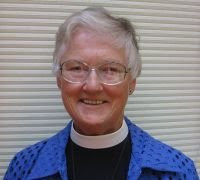
- Donna Ross
- I am a 'semi-retired' Episcopal priest, now assisting and teaching classes at St. Benedict's Episcopal Church in Los Osos, California. I have always been involved in interfaith groups, and I attended both Episcopal and Lutheran seminaries before my ordination in 1985. After ordination, I also completed an Internship in Spiritual Direction at the Jesuit Renewal Center in Milford, Ohio -- and in 'retirement,' I still serve as a spiritual director for women and men from many faith traditions. I served two Episcopal parishes in Ohio and one in California before retiring. Now I'm enjoying more opportunities to teach, especially through The Hollister Institute at St. Benedict’s Episcopal Church. I have been married for 50 years, have 3 children and 5 grandchildren, and many, many friends I've met through spiritual discussions.
No comments:
Post a Comment