Jesus' Unnamed Disciple
If any want to become my followers, let them deny themselves and take up their cross and follow me. (Mark 8:34f)
Over and over again, Jesus told his disciples that following him will call for great sacrifice – on his part, and on theirs as well. In "The Last Week", Marcus Borg and John Dominic Crossan put it this way: “To follow Jesus means to accept the cross, to walk with him against imperial violence and religious collaboration, and to pass through death to resurrection.”
But Jesus’ disciples didn’t seem to understand what it would mean to follow him. One of the running themes in Mark’s gospel is their continuing confusion – even their obtuseness. Time and time again the disciples don’t understand his teaching, his parables about the Kingdom, or even direct statements such as “The Son of Man is to be betrayed into human hands, and they will kill him....” (Mark 9:31).
And twice, after Jesus makes clear statements about his approaching death, they argue among themselves – not about how to find the strength to follow Jesus, but about which of them would be the greatest when his Kingdom was finally established. While Jesus called them to have the humility of servants, at least some of the disciples saw themselves as future rulers, like the lords and kings they knew in the gentile world. But it was that same world of domination and oppression that Jesus was confronting in Jerusalem.
One disciple, Judas, would decide to collaborate with the religious authorities, betraying Jesus. Note that Mark doesn’t give us a reason for Judas’ betrayal but simply records it, in the process pointing to Judas as the model of an unfaithful disciple. In opposition to the choice Judas makes, there is another follower who shows true discipleship: an unnamed woman who, with other women, had also followed Jesus on the way.
This woman came with a jar of costly ointment and poured the fragrant oil over Jesus’ head. The other disciples scolded her for wasting the costly ointment, but Jesus said, “Let her alone... She has performed a good service for me... She has done what she could; she has anointed my body beforehand for its burial...” (Mark 14:3f)
This unnamed woman seems to have been the first to understand what he was saying: On the way to the Kingdom, Jesus was going to die. After her anointing Jesus said to them all: "Truly I tell you, wherever the good news is proclaimed in the whole world, what she has done will be told in remembrance of her.” (Mark 14:9).
It is ironic that history has forgotten the name of this woman who was held up by Jesus as the model disciple. Borg and Crossan write: “She is, for us, the first Christian. And she believed the word of Jesus before any discovery of an empty tomb. Furthermore, her action was a graphic demonstration of the leadership model Jesus called for...”
The unnamed woman was a model disciple: trusting in Jesus’ word, fearless of the consequences, and serving not in power but in humility. What would have happened if the early church took this unnamed woman as its model for true discipleship?
If we followed her example, what would the church look like today?
If we followed her example, how could we challenge the domination systems of our own time?

Donna Ross

About Me
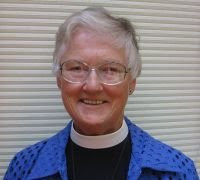
- Donna Ross
- I am a 'semi-retired' Episcopal priest, now assisting and teaching classes at St. Benedict's Episcopal Church in Los Osos, California. I have always been involved in interfaith groups, and I attended both Episcopal and Lutheran seminaries before my ordination in 1985. After ordination, I also completed an Internship in Spiritual Direction at the Jesuit Renewal Center in Milford, Ohio -- and in 'retirement,' I still serve as a spiritual director for women and men from many faith traditions. I served two Episcopal parishes in Ohio and one in California before retiring. Now I'm enjoying more opportunities to teach, especially through The Hollister Institute at St. Benedict’s Episcopal Church. I have been married for 50 years, have 3 children and 5 grandchildren, and many, many friends I've met through spiritual discussions.
If the church followed the example of this model disciple, we would attend more to one another's spiritual and physical needs and care less about power and reputation.
ReplyDeleteWe might have fewer hierarchical structures and more service focus--how do we organize to serve those in need?
ReplyDeleteThe generous and deeply perceptive act of the woman is a daunting example of the life of a follower of Jesus. She took what she had--the best that she had, and gave it to nurture the One whose love and caring miraculously cured human suffering. Like the young boy with the fish and loaves he shared with the Teacher--he gave what he had.
ReplyDeleteWhat do we have to share? Will we share it, even if it is not Jesus before our eyes?