Jesus Last Supper
As we have walked through the last week of Jesus’ life, guided by Marcus Borg and Dominic Crossan in their book, “The Last Week,” we have seen how carefully Jesus planned his entrance into Jerusalem. While we may have always thought of “Palm Sunday” as Jesus’ triumphant arrival in the holy city, his entrance was meant to be in deliberate contrast to triumphant Roman military parades: Jesus was coming to Jerusalem in the name of a very different kingdom.
Now we come to Thursday of Holy Week, and we see that Jesus also carefully planned his Last Supper with his disciples. As the host at this Supper, Jesus would help his disciples look back to events in his public ministry – and he would also point them forward, beyond his death into the future. So while we may call this meal the “Last Supper”, Borg and Crossan say it is also “the First Supper of the future.”
That Supper has many levels of meaning, for the disciples and for us.
The Last Supper was a continuation of Jesus’ everyday meals. Wherever he went, he welcomed outcasts and sinners to his table, and was roundly criticized for violating the social rules of his day. “He eats with sinners” – how often do the gospels tell us this? (Mark 2:15f)
As the First Supper, what does Jesus’ inclusion of sinners and outcasts mean to us? Who is included in the ongoing Suppers of our own faith communities?
The Last Supper recalled Jesus’ feeding of the 5,000 – where he took the bread that was available, blessed it, broke it, and gave it to everyone. Mark’s gospel tells us all were filled – no one was left out. (Mark 6:45f) Mark also tells us that there was another meal for thousands – the feeding of 4,000 in the gentile territories of the Decapolis. (Mark 8:1f) In both instances, Jesus fed everyone who was there, without questions, without qualifications. In both feedings, also, Jesus called upon his disciples to help feed the people, telling them, “You give them something to eat.”(Mark 6:37)
As the First Supper, what does Jesus’ feeding of everyone mean to us? In the ongoing Suppers of our churches, how do we share our meal with others beyond our own intimate communities?
The Last Supper was a Passover meal. Every Passover, Jews around the world and throughout the ages have been commanded to celebrate their release from the domination of the Egyptian Pharaoh. As a Passover meal, Jesus’ Last Supper would remind his disciples that in Jesus’ kingdom they were being delivered from slavery into freedom. The Supper brought the long-ago deliverance from Egypt into the present: God always desires to liberate us.
As the First Supper, what does Jesus’ remembrance of the Exodus mean to us? In the ongoing Suppers of our own churches, how are we being equipped to celebrate and share our freedoms with others?
The Last Supper pointed to Jesus’ coming sacrifice. He took up the bread, just as he had done at the feeding of the 5,000. But he then identified the bread with his own body, which was about to be broken on the cross. As he lifted the cup, he spoke of his blood, which was about be poured out in his death. For the disciples, and for us, there is no escaping Jesus’ meaning: his death was upon him. But what would his death mean? Borg and Crossan believe that his sacrifice would not be a substitution – that is, it would not be a punishment for the sins of others. Rather, it was to be the binding sacrifice, the spiritual communion, that would make God’s love, God’s inclusiveness, God’s empowerment, available to all.
As the First Supper, how do our Communion meals bind us together in sacrifice, in commitment to making God’s inclusiveness, God’s empowerment, God’s love, available to all?
Jesus’ Suppers are about God’s justice. Every meal Jesus shared – from dinner in the house of a tax collector, to the loaves and fishes distributed in Galilee, to the bread and wine distributed in Jerusalem – made God’s justice present. In every meal, Jesus was demonstrating that all of us, rich or poor, family or stranger, religiously observant or not, are guests on this earth created by God – and if we are invited to God’s Table, so also is everyone else in God’s creation. So the Supper is not about who belongs – it is about everyone belonging.
Jesus’ Suppers are about God’s sacrificial love. The Last Supper also pointed to sacrifice: Jesus was about to die a violent death from human injustice. God did not demand that Jesus die as a punishment for our sins; but Jesus was willing to die to show the lengths to which God’s love – and God’s call for justice – will go. Jesus' death was not to bring about a magical wiping away of the world’s sin; it was instead a deadly confrontation with the world’s sin, which would demonstrate the road to liberation from sin. So the Supper is not just about Jesus’ facing death for us – it is also about our facing death for others, in the Name of Justice, in the Name of Love.
In the First Suppers of our own faith communities, what does it mean to share bread and wine in Communion – this sacred meal of inclusion, of service, of sharing and of sacrifice? By participating in this meal, will we find comfort and inclusion, but escape our own sacrifice? No, Borg and Crossan write, we must understand that our First Suppers are not only about Jesus’ sacrifice, but our own. We have been called to participate in Jesus’ life, death and resurrection. If we live with him – if we are to live in him, then we must go forward with him.
What do we mean by “going forward” with Jesus?
If we are in Christ, we are embraced in his inclusiveness – and we therefore embrace others.
If we are in Christ, we are served by his love – and reach out to serve others.
If we are in Christ, we celebrate our own liberation – and we reach out to help liberate others.
If we are in Christ, we are included in his sacrifice – and we sacrifice ourselves for others.
From Borg and Crossan, one last time: “It is by participation with Jesus, and in Jesus, that his followers were to pass through death to resurrection, from the domination life of human normalcy to the servant life of human transcendence... The Last Supper is about bread for the world, God’s justice against human injustice, a New Passover from bondage to liberation, and participation in the path that leads through death to new life.” ("The Last Week," p. 120)
Does this understanding of Christianity give you a faith that empowers you to live for the world, as Jesus did?

Donna Ross

About Me
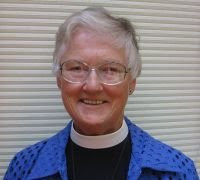
- Donna Ross
- I am a 'semi-retired' Episcopal priest, now assisting and teaching classes at St. Benedict's Episcopal Church in Los Osos, California. I have always been involved in interfaith groups, and I attended both Episcopal and Lutheran seminaries before my ordination in 1985. After ordination, I also completed an Internship in Spiritual Direction at the Jesuit Renewal Center in Milford, Ohio -- and in 'retirement,' I still serve as a spiritual director for women and men from many faith traditions. I served two Episcopal parishes in Ohio and one in California before retiring. Now I'm enjoying more opportunities to teach, especially through The Hollister Institute at St. Benedict’s Episcopal Church. I have been married for 50 years, have 3 children and 5 grandchildren, and many, many friends I've met through spiritual discussions.
This entry reminds me of the powerful experience of serving the homeless and hungry at the People's Kitchen. It is a First Supper event. I find that recipients appreciate a blessing before the meal, an explanation of specifically who made the dishes they choose, and an affirmative greeting of welcome. These are Eucharistic moments.
ReplyDeleteThank you for offering this blog.
Blessings!
fatty liver disease caused by medication fatty liver disease caused by
ReplyDeletemedication fatty liver disease caused by medication
Take a look at my web blog - herbal medicine for mild fatty liver