The Gospel according to Mark – 5th Week
A note as Mark’s story continues: We have now read our way through about a third of Mark’s gospel, and we see opposition to Jesus and his message beginning to mount. This week’s section tells about a healing on the Sabbath, as well as stories about two women – an old woman and a little girl. In all three healings, Jesus “breaks the rules”.
When Jesus had crossed again in the boat to the other side, a great crowd gathered round him; and he was by the lake. Then one of the leaders of the synagogue named Jairus came and, when he saw him, fell at his feet and begged him repeatedly, ‘My little daughter is at the point of death. Come and lay your hands on her, so that she may be made well, and live.’ So he went with him.
And a large crowd followed him and pressed in on him. Now there was a woman who had been suffering from hemorrhages for twelve years. She had endured much under many physicians, and had spent all that she had; and she was no better, but rather grew worse. She had heard about Jesus, and came up behind him in the crowd and touched his cloak, for she said, ‘If I but touch his clothes, I will be made well.’ Immediately her hemorrhage stopped; and she felt in her body that she was healed of her disease. Immediately aware that power had gone forth from him, Jesus turned about in the crowd and said, ‘Who touched my clothes?’ And his disciples said to him, ‘You see the crowd pressing in on you; how can you say, “Who touched me?” ’ He looked all round to see who had done it. But the woman, knowing what had happened to her, came in fear and trembling, fell down before him, and told him the whole truth. He said to her, ‘Daughter, your faith has made you well; go in peace, and be healed of your disease.’
While he was still speaking, some people came from the leader’s house to say, ‘Your daughter is dead. Why trouble the teacher any further?’ But overhearing what they said, Jesus said to the leader of the synagogue, ‘Do not fear, only believe.’ He allowed no one to follow him except Peter, James, and John, the brother of James. When they came to the house of the leader of the synagogue, he saw a commotion, people weeping and wailing loudly. When he had entered, he said to them, ‘Why do you make a commotion and weep? The child is not dead but sleeping.’ And they laughed at him. Then he put them all outside, and took the child’s father and mother and those who were with him, and went in where the child was. He took her by the hand and said to her, ‘Talitha cum’, which means, ‘Little girl, get up!’ And immediately the girl got up and began to walk about (she was twelve years of age). At this they were overcome with amazement. He strictly ordered them that no one should know this, and told them to give her something to eat.
He left that place and came to his home town, and his disciples followed him. On the sabbath he began to teach in the synagogue, and many who heard him were astounded. They said, ‘Where did this man get all this? What is this wisdom that has been given to him? What deeds of power are being done by his hands! Is not this the carpenter, the son of Mary and brother of James and Joses and Judas and Simon, and are not his sisters here with us?’ And they took offence at him. Then Jesus said to them, ‘Prophets are not without honour, except in their home town, and among their own kin, and in their own house.’ And he could do no deed of power there, except that he laid his hands on a few sick people and cured them. And he was amazed at their unbelief.
Then he went about among the villages teaching. He called the twelve and began to send them out two by two, and gave them authority over the unclean spirits. He ordered them to take nothing for their journey except a staff; no bread, no bag, no money in their belts; but to wear sandals and not to put on two tunics. He said to them, ‘Wherever you enter a house, stay there until you leave the place. If any place will not welcome you and they refuse to hear you, as you leave, shake off the dust that is on your feet as a testimony against them.’ So they went out and proclaimed that all should repent. They cast out many demons, and anointed with oil many who were sick and cured them.
King Herod heard of it, for Jesus’ name had become known. Some were saying, ‘John the baptizer has been raised from the dead; and for this reason these powers are at work in him.’ But others said, ‘It is Elijah.’ And others said, ‘It is a prophet, like one of the prophets of old.’ But when Herod heard of it, he said, ‘John, whom I beheaded, has been raised.’ (For Herod himself had sent men who arrested John, bound him, and put him in prison on account of Herodias, his brother Philip’s wife, because Herod had married her. For John had been telling Herod, ‘It is not lawful for you to have your brother’s wife.’ And Herodias had a grudge against him, and wanted to kill him. But she could not, for Herod feared John, knowing that he was a righteous and holy man, and he protected him. When he heard him, he was greatly perplexed; and yet he liked to listen to him. But an opportunity came when Herod on his birthday gave a banquet for his courtiers and officers and for the leaders of Galilee. When his daughter Herodias came in and danced, she pleased Herod and his guests; and the king said to the girl, ‘Ask me for whatever you wish, and I will give it.’ And he solemnly swore to her, ‘Whatever you ask me, I will give you, even half of my kingdom.’ She went out and said to her mother, ‘What should I ask for?’ She replied, ‘The head of John the baptizer.’ Immediately she rushed back to the king and requested, ‘I want you to give me at once the head of John the Baptist on a platter.’ The king was deeply grieved; yet out of regard for his oaths and for the guests, he did not want to refuse her. Immediately the king sent a soldier of the guard with orders to bring John’s head. He went and beheaded him in the prison, brought his head on a platter, and gave it to the girl. Then the girl gave it to her mother. When his disciples heard about it, they came and took his body, and laid it in a tomb.)
Thinking about the story: What will happen as a result of Jesus’ refusal to live within the “box” the political, cultural and religious leaders of his time constructed? Imagine that you are one of those whom Jesus sent out two by two – taking nothing with you except the clothes on your back and the shoes on your feet – to proclaim his message of healing love. If you could summon the courage to go out, what obstacles would you face today? What would be your greatest fear? In the twenty-first century, is it still dangerous to step outside the “boxes” constructed by our own cultures?

Donna Ross

About Me
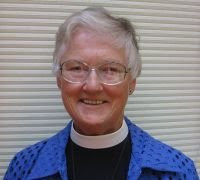
- Donna Ross
- I am a 'semi-retired' Episcopal priest, now assisting and teaching classes at St. Benedict's Episcopal Church in Los Osos, California. I have always been involved in interfaith groups, and I attended both Episcopal and Lutheran seminaries before my ordination in 1985. After ordination, I also completed an Internship in Spiritual Direction at the Jesuit Renewal Center in Milford, Ohio -- and in 'retirement,' I still serve as a spiritual director for women and men from many faith traditions. I served two Episcopal parishes in Ohio and one in California before retiring. Now I'm enjoying more opportunities to teach, especially through The Hollister Institute at St. Benedict’s Episcopal Church. I have been married for 50 years, have 3 children and 5 grandchildren, and many, many friends I've met through spiritual discussions.
I can't but think how someone doing today what the disciples did would be considered a crazy fool. Our boxes are comfortable. We know their dimensions and have become satisfied living within them. That's why Jesus picked the unexpected, the disenfranchised, to go out on his behalf. We need to look for these people in our culture today and listen to them. What's more, we need to have the faith and courage to risk what we have for what we might become. Interestingly, this was too much for anyone, even Niccodemus, to embrace fully. The price of what we'd give up feels too high. Come, Lord Jesus, come!
ReplyDelete