The Gospel according to Mark – 7th Week
A note as Mark’s story continues: This section of Mark’s story reveals the strict boundaries that divided Jews from Gentiles in the Galilee of Jesus’ time – rules for eating and drinking, rules for washing and cleansing, rules for separating members of different faiths. But the passage also tells the story of the Gentile woman who begged Jesus to heal her daughter – and the surprising change in Jesus’ understanding of his ministry. Finally, the story shows Jesus feeding another crowd until their hunger, too, was satisfied – but these people were living in the Decapolis (that is, the “ten cities”, Greek-speaking cities inhabited by Gentiles).
Now when the Pharisees and some of the scribes who had come from Jerusalem gathered around him, they noticed that some of his disciples were eating with defiled hands, that is, without washing them. (For the Pharisees, and all the Jews, do not eat unless they thoroughly wash their hands, thus observing the tradition of the elders; and they do not eat anything from the market unless they wash it; and there are also many other traditions that they observe, the washing of cups, pots, and bronze kettles.) So the Pharisees and the scribes asked him, “Why do your disciples not live according to the tradition of the elders, but eat with defiled hands?”
He said to them, “Isaiah prophesied rightly about you hypocrites, as it is written,
‘This people honors me with their lips,but their hearts are far from me;
in vain do they worship me,teaching human precepts as doctrines.’
You abandon the commandment of God and hold to human tradition.”
Then he said to them, “You have a fine way of rejecting the commandment of God in order to keep your tradition! For Moses said, ‘Honor your father and your mother’; and, ‘Whoever speaks evil of father or mother must surely die.’ But you say that if anyone tells father or mother, ‘Whatever support you might have had from me is corban (that is, an offering to God)— then you no longer permit doing anything for a father or mother, thus making void the word of God through your tradition that you have handed on. And you do many things like this.”
Then he called the crowd again and said to them, “Listen to me, all of you, and understand: there is nothing outside a person that by going in can defile, but the things that come out are what defile.”
When he had left the crowd and entered the house, his disciples asked him about the parable. He said to them, “Then do you also fail to understand? Do you not see that whatever goes into a person from outside cannot defile, since it enters, not the heart but the stomach, and goes out into the sewer?” (Thus he declared all foods clean.) And he said, “It is what comes out of a person that defiles. For it is from within, from the human heart, that evil intentions come: fornication, theft, murder, adultery, avarice, wickedness, deceit, licentiousness, envy, slander, pride, folly. All these evil things come from within, and they defile a person.”
From there he set out and went away to the region of Tyre. He entered a house and did not want anyone to know he was there. Yet he could not escape notice, for a woman whose little daughter had an unclean spirit immediately heard about him, and she came and bowed down at his feet. Now the woman was a Gentile, of Syrophoenician origin. She begged him to cast the demon out of her daughter. He said to her, “Let the children be fed first, for it is not fair to take the children’s food and throw it to the dogs.” But she answered him, “Sir, even the dogs under the table eat the children’s crumbs.” Then he said to her, “For saying that, you may go—the demon has left your daughter.” So she went home, found the child lying on the bed, and the demon gone.
Then he returned from the region of Tyre, and went by way of Sidon towards the Sea of Galilee, in the region of the Decapolis. They brought to him a deaf man who had an impediment in his speech; and they begged him to lay his hand on him. He took him aside in private, away from the crowd, and put his fingers into his ears, and he spat and touched his tongue. Then looking up to heaven, he sighed and said to him, “Ephphatha,” that is, “Be opened.” And immediately his ears were opened, his tongue was released, and he spoke plainly. Then Jesus ordered them to tell no one; but the more he ordered them, the more zealously they proclaimed it. They were astounded beyond measure, saying, “He has done everything well; he even makes the deaf to hear and the mute to speak.”
In those days when there was again a great crowd without anything to eat, he called his disciples and said to them, “I have compassion for the crowd, because they have been with me now for three days and have nothing to eat. If I send them away hungry to their homes, they will faint on the way—and some of them have come from a great distance.” His disciples replied, “How can one feed these people with bread here in the desert?” He asked them, “How many loaves do you have?” They said, “Seven.” Then he ordered the crowd to sit down on the ground; and he took the seven loaves, and after giving thanks he broke them and gave them to his disciples to distribute; and they distributed them to the crowd. They had also a few small fish; and after blessing them, he ordered that these too should be distributed. They ate and were filled; and they took up the broken pieces left over, seven baskets full. Now there were about four thousand people. And he sent them away.
And immediately he got into the boat with his disciples and went to the district of Dalmanutha.
Thinking about the story: What happens when Jesus blurs the boundaries between Jews and Gentiles? Do you think the story of the Syrophoenician mother – a woman and a Gentile – would have been included in Mark’s gospel if Jesus’ changing attitude towards the Gentiles could have been told in another way? (Why is this story so important that Mark includes it, even if it does show a Gentile woman challenging him?) And what would this story have meant to the Gentile Christians who belonged to Mark’s church in Rome?

Donna Ross

About Me
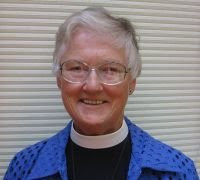
- Donna Ross
- I am a 'semi-retired' Episcopal priest, now assisting and teaching classes at St. Benedict's Episcopal Church in Los Osos, California. I have always been involved in interfaith groups, and I attended both Episcopal and Lutheran seminaries before my ordination in 1985. After ordination, I also completed an Internship in Spiritual Direction at the Jesuit Renewal Center in Milford, Ohio -- and in 'retirement,' I still serve as a spiritual director for women and men from many faith traditions. I served two Episcopal parishes in Ohio and one in California before retiring. Now I'm enjoying more opportunities to teach, especially through The Hollister Institute at St. Benedict’s Episcopal Church. I have been married for 50 years, have 3 children and 5 grandchildren, and many, many friends I've met through spiritual discussions.
No comments:
Post a Comment